
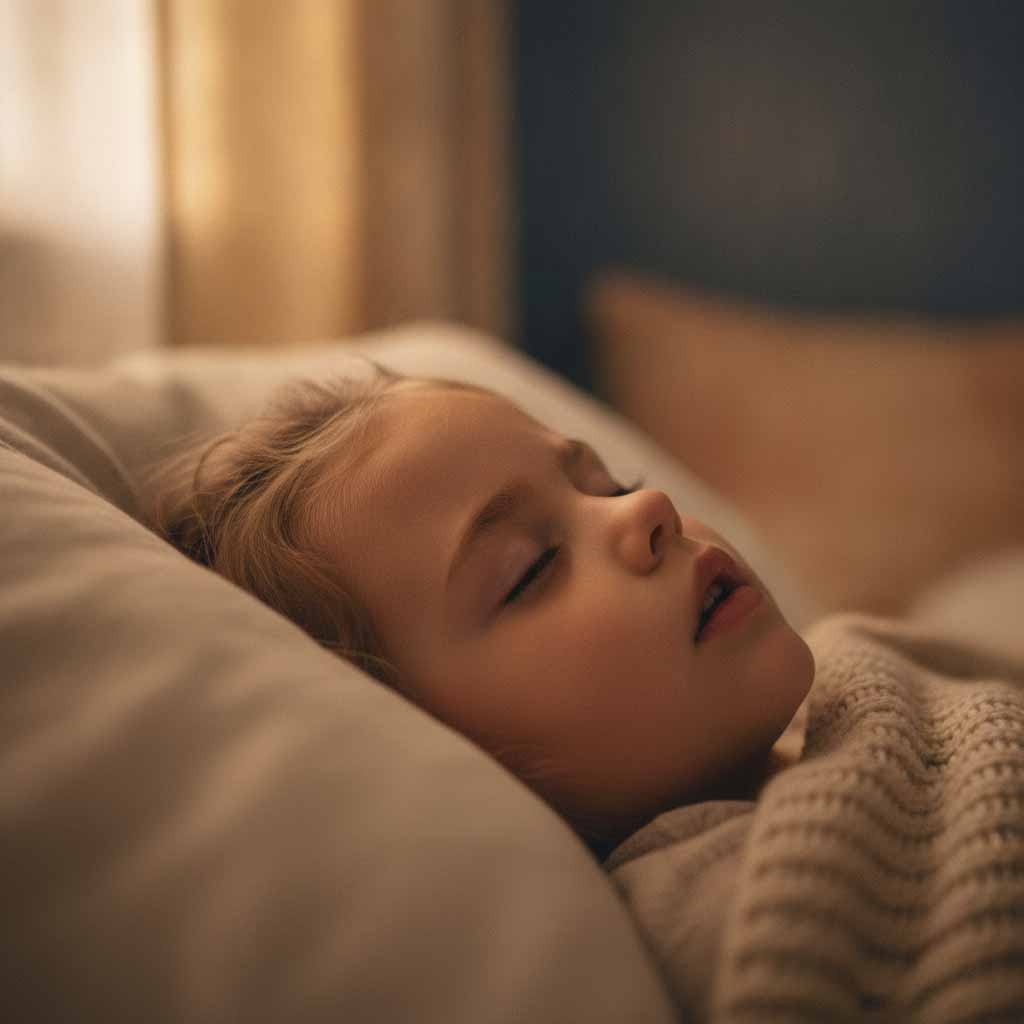
Hearing a child grind their teeth during sleep can be surprisingly loud and worrying.
Sleep bruxism is the term used for grinding or clenching during sleep, and it is relatively common in children. There is not one single explanation.
Rather than assuming it comes from stress, parasites or one nutritional deficiency, it is more useful to look at the child’s whole sleep pattern.
What Else Happens During Their Sleep?
Notice whether teeth grinding occurs alongside:
- Snoring
- Mouth breathing
- Sleeping with the mouth open
- Restless sleep
- Frequent waking
- Sweating
- Unusual sleeping positions
- Waking tired
These observations can provide useful context.
Can Snoring and Mouth Breathing Be Relevant?
Research on childhood bruxism has found associations with snoring, mouth breathing and other forms of disturbed sleep.
That does not mean mouth breathing causes every case of grinding, but the combination is worth paying attention to.
If your child regularly sleeps with their mouth open, see our article on mouth breathing in children.
What About Restless Sleep?
Some children who grind also move frequently, wake often or seem unsettled during the night.
A child may spend enough hours in bed but still wake unrefreshed if sleep quality is poor.
Can Poor Sleep Affect the Next Day?
Children with disrupted sleep may show:
- Irritability
- Tiredness
- Restlessness
- Difficulty concentrating
- Emotional sensitivity
- Early waking
Not every tired child looks sleepy. Some become more active.
Can Stress Play a Role?
Stress and emotional tension can influence sleep and muscle activity in some children.
School pressure, changes in routine, anxiety and busy schedules are worth considering, but they are only one part of the picture.
What About Nutrition?
Normal muscle and nervous-system function depends on adequate overall nutrition.
If teeth grinding occurs alongside restless sleep and a very restricted diet, we may review intake of iron, magnesium, zinc, vitamin D, B12, folate, protein and essential fatty acids.
Teeth grinding alone does not diagnose a nutritional deficiency.
Could Histamine Be Part of a Broader Pattern?
In selected children, grinding may occur alongside restless sleep, itching, eczema, congestion or a noticeable food pattern.
In that situation, histamine may be one factor worth exploring. We do not assume it is the cause of bruxism.
Keep a Sleep Diary
Record:
- When grinding occurs
- Snoring
- Mouth breathing
- Night waking
- Restlessness
- Congestion
- Itching
- Bedtime routine
- Morning mood and energy
A week or two of observations can show whether grinding is isolated or part of a broader sleep pattern.
Related Reading
- sleep problems in children
- enlarged tonsils and adenoids
- anxiety in children
- Histamine in Children: Could Food Be Affecting Sleep, Mood and Behaviour?
- Why Does My Child Wake During the Night?
- Mouth Breathing in Children: What Else Should Parents Look For?
Ready to Better Understand Your Child’s Health?
If these patterns sound familiar, our team can look at your child’s nutrition, digestion, sleep, growth and lifestyle together to understand which factors may be relevant to their individual presentation.
The Children’s Naturopath supports children and families through consultations at our St Kilda clinic in Melbourne and by phone throughout Australia, New Zealand and internationally.